

AnthonyFlood.com
Philosophy against Misosophy


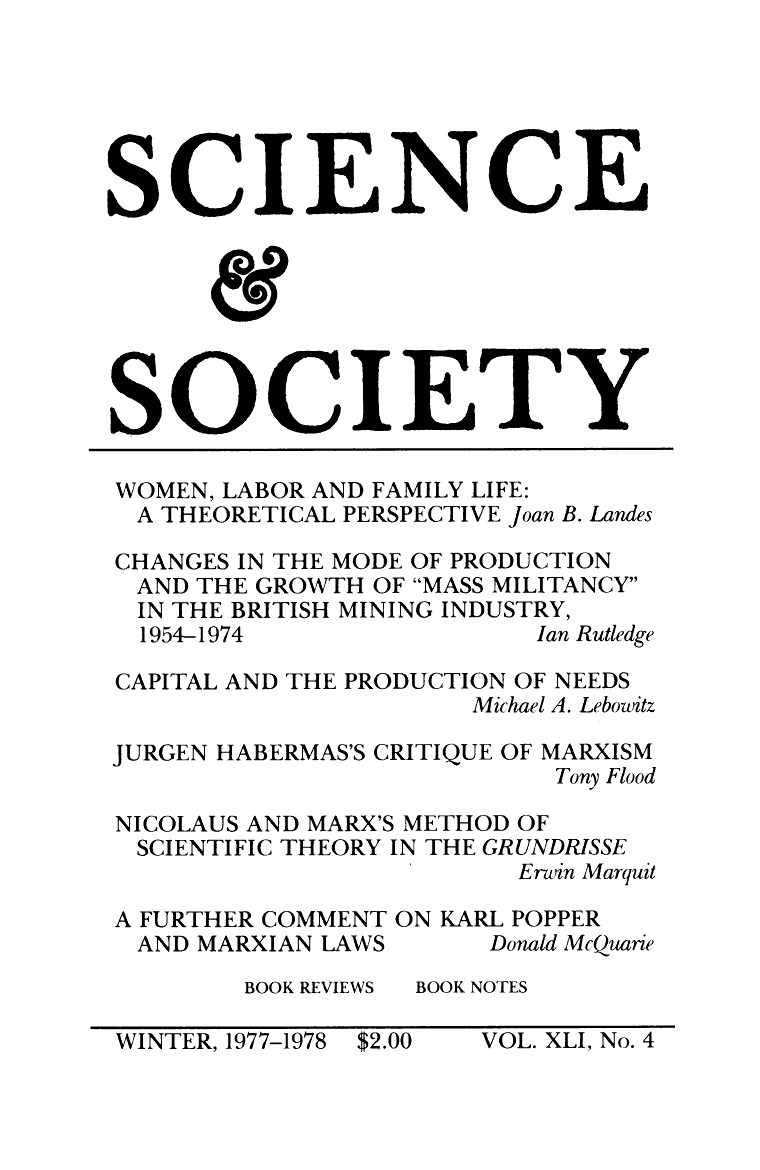
From Science & Society, XLI:4, Winter 1977-1978, 448-64. This essay records not only the beginning of the end of my Marxism, but also an incipient conviction, then a mere suspicion, that one thing a philosopher ought to avoid is to make problematic the existence of philosophical criticism. In my view, that's what every materialist does.
For readers in a hurry, here are the key paragraphs from Section III:
Marx does not view the interest in social identity as a relatively autonomous human dimension, but rather relegates it to a subordinate aspect of the interest in control over nature.
In Marx’s writings, Habermas argues, one finds that the “absolute ego of social production is founded in a history of nature that brings about the tool-making animal as a result.” [36]
Marx himself declared that human beings “begin to distinguish themselves from animals as soon as they begin to produce their means of subsistence, a step that is conditioned by their bodily organization” and that the “first state of affairs of which to take note is therefore the bodily organization of these individuals and the relation it sets up between them and the rest of nature.”[37]
In other words, what is distinct about the human species is—above all, if not solely—its instrumental relation to nature.
Here Habermas differs with Marx. For Habermas, the human species’ interests in identity and control over nature are coequal and distinct aspects of the species’ self-generative act.
If what Marx claimed on this point were literally true, Marx’s own critique of mystificatory ideology would be incomprehensible because that critique by no means logically follows from the concept of capitalist production.
It can only be comprehended as an instance of human self-comprehension which, as we have attempted to argue earlier in this paper, must be brought under the categorical framework of symbolic interaction.
By restricting himself to the categorical framework of instrumental action, Marx is forced to misconceive his own critique as natural science.
This paper, despite its many infelicities, was one of the first on its topic. (See the note appended to this essay.)
Anthony Flood
Update August 18, 2019
Jürgen Habermas's Critique of Marxism
Anthony Flood
Jürgen Habermas’s assessment of Marxism consists of both a defense and a critique. According to Habermas, Marx held the key to incorporating the German idealistic philosophical tradition into his critique of Hegel’s philosophy of subject-object identity, but failed to use it fully.
In Habermas’s view, Marx only partially resisted positivistic social theory’s attack upon epistemology and consequently adopted a framework of sociological inquiry that actually prevents critical self-reflection, the methodological foundation of the theoretical recognition of the human interests in identity, control over nature, and emancipation.
In spite of Marx’s obvious concern for the self-emancipation of the human species, his naturalistic theoretical framework, Habermas contends, cannot articulate that freedom’s realization except as the automatic by-product of natural-historic evolution.
We shall here examine Habermas’s theory of “cognitive interests” insofar as it determines his critique of Marxism, to which critique we shall then turn. I hope to show that Habermas’s view of Marxism is a sympathetically critical one from Marxists should learn, even as they attempt to answer it.
I
Habermas’s critique, which is founded upon a notion of reflectively grasped cognitive interests, avoids the “circle” of every epistemological enterprise while simultaneously making necessary a “materialization” of epistemology. This “circle” of epistemology may be understood in the following way.
Consider that for any proposition p and a particular epistemological criterion c, one may claim that “I know p by appeal to c.” The problem is to determine what criterion one appeals to when p = c.
Clearly, c is eliminated as a possibility since in this case its own truth happens to be in question; on the other hand, any metacriterion, for example c’, shares the same difficulty as c.
The application of a criterion of truth to itself is circular and consequently meaningless, while any termination of the theoretically endless series of “criteria of criteria” is just as irrational.
This is the substance of Hegel’s criticism of the epistemological enterprise whose most famous practitioner was Immanuel Kant.
The whole justification-framework must be abandoned as wrong-headed as well as theoretically impossible, for, as Habermas quotes Hegel, what “is demanded is thus the following: we should know the cognitive faculty before we know. It is like wanting to swim before going in the water. The investigation of the faculty of knowledge is itself knowledge and cannot arrive at its goal because it is this goal already.”[1]
For Hegel, phenomenological self-reflection accomplishes what epistemology hopes to, but cannot, bring to pass: the establishment of the foundation of knowledge as certain, that is, invulnerable to the attacks of unconditional doubt.
Since the removal of such doubt is a process internal to the thinking subject, that process cannot be completed via non-subjective argumentation. If a criterion does remove doubt, then it is already one with the certain knowledge that is sought; therefore, it is meaningless to refer to it as a criterion, as if to distinguish its existence from its object, the unassailable foundation of knowledge.
What is this reflection, then? It is essentially a remembering of knowledge already in one’s own possession. To go through the motions of erecting a justification external to a given knowledge-claim and then to “apply” it to that claim so as to “verify” the latter is to engage in self-deception. All one needs to do is to note the immediacy of the knowledge one is unnecessarily trying to justify. Reflection uncovers this immediacy and recognizes it as the foundation sought.
This foundation of science, which one can immediately grasp through phenomenological self-reflection, is for Hegel the principle of subject-object identity. This identity, or Absolute Knowledge, is a truth unrecognized by us in our everyday consciousness.
In the Phenomenology of Spirit, Hegel tries to demonstrate that this identity is hidden under layers of consciousness which can be phenomenologically penetrated, starting with the pseudo-”immediacy” of Sense-Certainty.
Our purpose here is not to travel the Phenomenology’s tortuous path from this pseudo-”immediacy” to true, subject-object immediacy, even if we were capable of doing so.
We must instead focus on Habermas’s retention of Hegel’s concept of self-reflection along with his rejection of Hegel’s philosophy of identity.
For Habermas, self-reflection uncovers knowledge-constitutive interests which inhere in Reason and which are more fruitfully articulated within the framework of a social theory than in that of an absolute idealism.
Habermas accepts Hegel’s critique of epistemology without fully accepting what Hegel offers as a solution, just as he accepts Marx’s critique of Hegel without fully accepting Marx’s sociological framework.
According to Habermas, Hegel never really demonstrates subject-object identity in his famous work, but rather assumes its possibility beforehand and then contrives a literary path which “leads” one to its (pre)destination. This undercuts the force of Hegel’s argument and compels us to look elsewhere for the foundations of a critical, non-positivistic social theory.[2]
Habermas’s materialism is affirmed in his criticism of Hegel’s conception of nature as the alienation of Logic, which alienation is overcome in self-conscious Spirit which recognizes nothing outside itself. As Habermas writes (concurring with Marx):
Nature cannot be conceived as the other of a mind that is at the same time in its own element. For if nature were mind in the state of complete externalization, then as congealed mind it would have its essence and life not in itself but outside itself. There would be an advance guarantee that in truth nature could exist only as mind reflexively remembers it while returning to itself from nature.[3]
For Habermas, as for Marx, this proposition is intolerably false: nature does not owe its existence to any stage in the development of Spirit. Spirit and mind are always human spirit and mind, and insofar as humanity has a natural origin, nature must precede mind—logically as well as chronologically—as mind’s “absolutely ground.”[4]
Thus, “the seal placed on absolute knowledge by the philosophy of identity is broken if the externality of nature . . . not only seems external to a consciousness that finds itself within nature but refers instead to the immediacy of a substratum on which the minds contingently depends.”[5]
Thus Habermas has difficulties with both ends of the spectrum from Kant to Hegel. But as we shall see, the insights gained from his study of Kant, Fichte, and Hegel lead Habermas to the conclusion that Marx failed to present enough of the sociological picture: according to Habermas, Marx overreacted to Hegel’s dialectics of interaction, even though the latter are themselves the product of a philosophical one-sidedness and are embedded in an idealism rejected by both Marx and Habermas.
In Habermas’s view, Marx contributed an indispensable—perhaps the more important part—of the picture through his dialectics of labor, and for this we owe him much. But insofar as Marx presented his partial truth as the whole truth, it must be corrected to account for a feature of human existence which claims a status equal to that of labor. We shall return to Habermas’s criticism of Marx after examining the former’s categories of knowledge-constitutive interests.
By “interests,” Habermas means
the basic orientations rooted in specific fundamental conditions of the possible reproduction and self-constitution of the human species, namely work and interaction . . . . Knowledge-constitutive interest can be described exclusively as a function of the objectively constituted problems of the preservation of life that have been solved by the cultural forms of existence as such.[6]
Already we may note that Habermas has not one but two categories articulating conditions of human existence, namely, “reproduction and self-constitution,” which respectively are referred to by “work and interaction.”
In this view, knowing does not occur outside the context of society: knowledge is constituted by the interests that are generated by the above-mentioned “fundamental conditions” of human existence.
Human beings have two basic orientations that determine their survival and development, one toward nature and another toward each other.
While these two orientations or interests are internally related to each other, and though the activities each generates together form a unity in what Habermas calls “material synthesis,” they must remain distinguishable at the level of socio-historical investigation. A closer look at these two interest in now in order.
The technical cognitive interest (TCI) may be referred to as the interest in control over natural processes. The relationship of man to nature is logically invariant and is well-articulated in the dictum of Francis Bacon that nature, to be commanded, but first be obeyed. The human species empirically accumulates and rationally organizes information into laws from which can be derived technical rules whose employment extends human control over nature.
TCI’s operate in what Habermas calls systems of purposive-rational (instrumental and strategic) action (PRAS’s). The man-nature relationship is essentially a means-end affair in which nature is transformed instrumentally, i.e., to realize certain human ends.
Human beings approach their natural environment monologically: nature is not “consulted” about what is done to it or said about it.
The TCI is also referred to by Habermas as the Kantian moment of material synthesis.
The practical cognitive interest (PCI) may be referred to as the interest in identity. Human beings do not simply relate to nature: they must relate to each other in a definite fashion. They have a conception of themselves that they retain in their practical conduct and which partially determines this conduct, i.e., what is undertaken in PRAS’s.
Human beings expect certain behavior from each other, not just from nature. These mutual expectations are articulated in intersubjectively shared ordinary language in the form of social norms which govern what Habermas calls symbolic (communicative) interaction systems (SIS’s).
These systems refer to the various ways human beings practically organize themselves to achieve social ends.
The self-conception of the social subjects determines how they deal with nature, their object. In organizing themselves, human beings become their own objects; but owing to their subjectivity, they cannot really treat themselves like the objectified processes of nature.
In other words, while PRAS’s entail a subject-object relation that is monologic in character, SIS’s entail a subject-object relation that is really a subject-subject relation which is necessarily dialogic in nature: the “object” (really, human subjects) has a say about is done to “it” or said about “it”; if it does not have such a say the subject matter has been entirely misunderstood.
Insofar as SIS’s do not involve a deference to the object (as in PRAS’s), but rather a positing of the subject itself, Habermas refers to the PCI as the Fichtean moment of material synthesis.
The TCI and the PCI form a dialectical unity in material synthesis which as a whole is guided by the more general human interest in autonomy and responsibility, or in a word, freedom. This interest in overcoming domination by both nature and by fellow human beings underlies PRAS’s and SIS’s, while each of these systems is guided by its own cognitive interest.
This overarching knowledge-constitutive interest is what Habermas calls the emancipatory cognitive interest (abbreviated hereafter as ECI); it is the Hegelian moment unifying the other two.
The ECI is the lifeline of Reason: Reason inheres in the interest in freedom.[7] Reason “lives” in the reflexive remembering which draws out the transcendental aspects of human existence (the TCI and the PCI). To quote Habermas:
[In] the experience of the emancipatory power of reflection . . . the subject . . . becomes transparent to itself in the history of its genesis. Methodically it leads to a standpoint from which the identity of reason with the will to reason freely arises. In self-reflection, knowledge for the sake of knowledge comes to coincide with the interest in autonomy and responsibility. For the pursuit of reflection knows itself as a moment of emancipation. Reason is at the same time subject to the interest in reason. We can say that it obeys an emancipatory cognitive interest, which aims at the pursuit of reflection.[8]
Freedom is both striven for and known: it is neither effortlessly nor unconsciously acquired and enjoyed.
Freedom as a condition of human existence marked by autonomy and responsibility is a goal which is at once an object of theory and practice. The interest in freedom is thus an inseverable bond of theory and practice.
Habermas takes these explicitly Hegelian themes of freedom and reason very seriously, but secures them within a materialistic critique of Hegel’s philosophy of subject-object identity and of Hegel’s theoretical treatment of nature as the alienation of mind. While Marx, Habermas acknowledges, was the first to provide the basis of a non-idealistic rendering of Hegel’s insights into social reality, Marx unfortunately overreacted to Hegel’s dialectics of the interaction between consciousnesses.
In Habermas’s view, Marx, in his justified rejection of Hegel’s absolute idealism, nonetheless cut himself off from what must be preserved, even if transformed. He replaced one one-sidedness with another: he attempted to let man’s invariant relation to nature, rather than intersubjective interaction, tell the whole story.
Habermas believes we must reassess Marx’s contributions to identify and criticize those elements in his writings which have given rise to positivistic misinterpretations of his more dialectical intentions.
II
In his essay, “Labor and Interaction: Remarks on Hegel’s Jena Philosophy of Mind,”[9] Habermas argues that Hegel once held labor to be a constitutive moment of developing Spirit along with language and interaction (action based on mutual expectation), but later abandoned this perspective.
From about the time he wrote the Phenomenology (1806) until his death, Hegel maintained a philosophy of Spirit which subordinated language to a mediation of imagination and memory within “subjective spirit,” while labor as instrumental action disappears entirely. Social labor is dealt with under the rubric “systems of needs” within “objective spirit,” which is manifested in the realm of law and politics.[10]
But because of the truth of a proposition recognized in his earlier system, namely (as Habermas puts it), that “[i]nstrumental action, at least when solitary, is monologic action,”[11] Hegel later faced the difficulty of expressing such action within his philosophy of universal interaction.
Labor as social labor, as need-satisfaction, as a system of intersubjective cooperation, fits easily within such a philosophy; but this is simply not true for labor as instrumental action, as a relation between subject and a non-subject (nature).
As Marx wrote, the externality of nature was for Hegel “an alienation, a fault, a weakness that should not exist.”[12] Hegel attempted to “eliminate” this weakness by conceiving nature not merely as object (Gegenstand), but as adversary (Gegenspieler) as well.
Instrumental activity upon nature is not a problem if nature is not an externality at all, but an alienation. Alienation can occur only within and for a consciousness which merely appears to itself as something external to itself.
In Hegel’s Encyclopedia of the Philosophical Sciences, sec. 384, Habermas finds that the
manifesting which . . . is the becoming of nature, as the manifesting of spirit, which is free [in history], is the positing of nature as the spirit’s world; a positing which as reflection is at the same time a prepositing of the world as independent nature.[13]
We may recall our earlier discussion of Habermas’s and Marx’s criticisms of Hegel’s conception of a nature which exists only insofar as Spirit “reflexively remembers” it.
We can now see that Hegel needed this patently untenable notion in order to be able to apply his principle of interaction universally.
Hegel was able to deal with labor only if he first reduced it to interaction, to a struggle for recognition. Habermas explains that if
hidden subjectivity can always be found in what has been objectivized, if behind the masks of objects, nature can always be revealed as the concealed partner, then the basic dialectical patterns of representation [i. e., language—T.F.] and labor can also be reduced to one common denominator with the dialectics of moral action [i.e., interaction—T.F.]. For then the relationship of the name-giving and the working subject can also be brought within the configuration of reciprocal recognition.[14]
Nature is thus conceived as an object “with which interaction in the mode of that between subjects is possible.”[15] Therefore, if nature is alienated Spirit, then the goal “is not the appropriation of what has been objectified, but instead the reconciliation, the restoration of the friendliness which has been destroyed.”[16]
For Habermas, as for the younger Hegel, labor and interaction are heterogenous, irreducible to each other. This heterogeneity, as Habermas sees it, is the basis for rejecting both Hegel’s and Marx’s theoretical frameworks.
Hegel elevates nature to the status of subject, the Other of Spirit. But Spirit is everything: between Spirit and its illusory Other, neither interaction nor communication is possible as either of them are possible between finite subjects, for “absolute spirit is solitary.”[17]
Thus, in attempting to universalize interaction, Hegel destroys it at the level of Absolute Spirit. On the other hand, a purely external nature is just as disastrous for his philosophy of identity. The human species’ instrumental, monologic relationship to nature asserts itself in the face of Hegel’s attempt to dissolve it or ignore it in his system.
This truth, however, is still only part of the story, and any attempt, such as Marx’s, to extend it to the social totality in its entirety is wrong, in Habermas’s view. It leads to errors that are perhaps more “persuasive”—and therefore more difficult to overcome—than those that follow from Hegel’s opposite onesideness with its resultant counter-intuitive idealism.
However, Habermas’s critique of Marxism is nonetheless Hegelian insofar as it places the dialectics of interaction next to Marx’s dialectics of labor.
We trust that we have already shown that Habermas is not interested in initiating an uncritical “back to Hegel” movement, but Habermas nonetheless believes that Hegel’s insights into the interactional dimension of human beings should not be thrown out with the philosophy of identity.
We must here note Habermas’s sympathy with Marx’s attempt to ground a critical social theory without succumbing to either Hegel’s idealism or to the then emergent positivistic attack upon philosophy. Habermas declares that
with Hegel . . . a fatal misunderstanding arises: the idea that the claim asserted by philosophical reason against the abstract thought of mere understanding is equivalent to the usurpation of the legitimacy of independent sciences by a philosophy claiming to retain its position as universal scientific knowledge. But the actual fact of scientific progress independent of philosophy had to unmask this claim, however misunderstood, as bare fiction. It was this that served as the foundation-stone of positivism. Only Marx could have contested its victory. For he pursued Hegel’s critique of Kant without sharing the basic assumption of the philosophy of identity that hindered Hegel from unambiguously radicalizing the critique of knowledge.[18]
Habermas’s disagreement with Marx is over the categorical framework Marx employed in his investigations, a framework which “proves itself insufficient to establish an unconditional phenomenological self-reflection of knowledge and thus prevent the positivist atrophy of epistemology.
Considered immanently, I see the reason for this in the reduction of the self-generative act of the human species to labor.”[19]
Habermas does point out that Marx “rediscovered that interconnection between labor and interaction in the dialectic of the forces of production and the relations of production.”[20]
Indeed, in Marx’s concrete investigations one will find the categories “of material activity and revolutionary practice, of labor and reflection at once.”[21]
But, Habermas insists, “Marx interprets what he does in the more restricted conception of the species self-reflection through work alone.”[22]
Thus, while Marx contributes to the true radicalization of the critique of knowledge and actually surpasses the Hegelian viewpoint, he nonetheless articulates this achievement in terms that allow a positivistic misreading of his own works:
. . . [F]or Marx, instrumental action, the productive activity which regulates the material interchange of the human species with its natural environment, becomes the paradigm for the generation of all the categories; everything is resolved into the self-movement of production. Because of this, Marx’s brilliant insight into the dialectical relationship between the forces or production and the relations of production could very quickly be misinterpreted in a mechanistic manner.[23]
A mechanistic interpretation would be one that claims that human evolution is an automatic process whose driving force is the accumulation of technically exploitable knowledge and which results in the eventual displacement of all necessary labor by machine.
In such a view, the object of social science is essentially no different from that of natural science: knowledge in both cases simply involves the accumulation, organization, and interpretation of empirical data; a theory of knowledge is entirely unnecessary.
Human history, here, is viewed as an outgrowth of natural history. The human species’ interactional dimension, wherein lies the species’ specific difference (along with labor) from the rest of the animal kingdom, is lost in this view.
As a result, human self-comprehension becomes logically impossible, because such comprehension operates at the level of interaction.
This is precisely the positivist’s conclusion: social science is practically impossible due to the complexity of the data. Positivism does not see the object of social science on its own terms, but rather as an unmanageable variant of the “familiar” object of natural science.
The monologic relationship between the subject and the object is not questioned even when the object is neither the solar system nor molecules, but rather the class of subjects themselves, the human species. Positivism does not view the possibility of social theory as critique, as the critical self-reflection of social subjects.
Positivism, as Trent Schroyer defined it in his exposition of Habermas’s thought,
is that conception of knowledge which denies the possibility of reflective reconstruction of the transcendental principles presupposed in human activity.[24]
In such a methodological framework there is no room for critical selfreflection or, more significantly, for the revolutionary proletarian class consciousness Marx saw as a prerequisite for the overthrow of capitalism.
Habermas is convinced that these positivistic elements pervade Marx’s conception of what he was doing, but also that they contradict the thrust of his work. This work is certainly, despite the lack of adequate self-comprehension, an important attempt to develop a non-positivistic social theory.
Therefore, if the “transcendental principles presupposed in human activity”[25] can in fact be reflexively reconstructed—and Habermas’s theory of cognitive interests tries to reconstruct them—then positivism can be refuted and Marxism’s selfcomprehension can be brought in line with its actual scientific contribution.
We shall now take a closer look at Habermas’s account of this self-comprehension.
III
Habermas claimed that Marx developed implicitly a notion of material synthesis (or a materialistic notion of synthesis) which he opposed to the idealistic synthesis as developed by Kant, Fichte, and Hegel.
For Marx, the self-reflection of consciousness discloses the structure of social labor as that which synthesizes subject and object. Rejecting Hegel’s assumption of subject-object identity, Marx “does not view nature under the category of another subject, but conversely the subject under the category of another nature.”[26]
Unlike idealistic synthesis, material synthesis neither generates a logical structure, nor is it absolute: human labor, rather than transcendental consciousness, is the synthetic agent by which a socio-economic structure is constituted; and since the subject-object relation is historically determined and does not form an identity, it is not absolute.[27]
We should recall from our earlier discussion of cognitive interests that Habermas claims that there are two basic orientations of knowledge-constitutive interests which direct human activity: the TCI (Kantian moment) and the PCI (Fichtean moment).
Habermas’s critique of Marx amounts to the charge that Marx reproduces both moments of material synthesis, but reduces the PCI to a function of the TCI, thereby actually abolishing the former as a distinct, irreducible moment.
The Kantian moment reappears in Marx as the “invariant relation of the species to the natural environment, which is established by the behaviorial system of instrumental action—for labor processes are the ‘perpetual natural necessity of human life’ [Marx].”[28]
Also, the Kantian noumenon or unknowable thing-in-itself also reappears in Marx’s conception of nature. As Habermas explains Marx’s position:
No matter how far our power of technical control over nature is extended, nature retains a substantial core that does not reveal itself to us.[29]
Labor may determine how nature is relativized to human beings in any epoch, “but it does not eliminate the independence of its [nature’s] existence.”[30] The prior existence of the world is presupposed in productive activity, though “we ourselves have access to nature only within the historical dimension disclosed by labor processes.”[31]
This essentially Kantian thrust corrects
the idealist attempt to reduce nature to a mere externalization of mind [and] . . . preserves nature’s immovable facticity despite nature’s historical embeddedness in the universal structures of mediation constituted by laboring subjects.[32]
What labor does—and in doing so it parallels the activity of the Kantian transcendental ego—is to give form to preexistent “raw material.”
The Kantian subject can know only phenomena: the “things-in-themselves,” the things as they are apart from any experiential relation to a subject, pose no epistemological question and therefore, in principle, cannot be known.
Similarly, in “his production,” Marx wrote, “man can only proceed like nature herself, that is only by changing the forms of substances.”[33]
The difference between Kant and Marx is that whereas Kant’s cognitive process involves a logically unalterable set of categories that organize experience, Marx’s labor process transforms nature according to historically alterable technical rules; whereas Kant’s subject is never among the objects it structures, Marx’s subject is always in the process of being formed, not only directly by its own activity, but also by the environment it has a hand in forming.
The Fichtean moment receives an odd treatment in Marx’s framework: it virtually becomes an aspect of the Kantian moment. Consider this succinct and representative statement by Fichte:
In thinking of your present self-positing, which has been elevated to clear consciousness, you must conceive of another such positing having preceded it without clear consciousness; the present one refers to the latter and is conditioned by it.[34]
Marx’s materialism appropriates this conception as follows, according to Habermas: the social totality of laboring subjects confronts nature as an ego confronts a non-ego.
Yet pre-existing nature obtains its identity only through labor processes. As the labor process alters nature in time, thereby bringing about a change in itself, the laboring subjects themselves change; their identity therefore changes:
Each generation gains its identity only via a nature that has already been formed in history, and this nature in turn is the object of its labor. The system of social labor is always the result of the labor of past generations . . . . The present subject has in some sense been “posited” by the totality of preceding subjects, that is placed in a position to come to grips with nature at its historically determined level. Yet it cannot regard this totality as an alien subject. For the labor processes through which it [i.e., the totality of preceding subjects−T.F.] has been constituted themselves belong to the very same production in which it [i.e., the present subject−T.F.] is engaged and which it is merely carrying forward. In its labor the present subject comprehends itself by knowing itself to have been produced as by itself through the production of past subjects. [35]
For Marx, therefore, social identity is an achievement of labor: the species posits itself and thereby forms itself only in the process of transforming nature.
Marx does not view the interest in social identity as a relatively autonomous human dimension, but rather relegates it to a subordinate aspect of the interest in control over nature.
In Marx’s writings, Habermas argues, one finds that the “absolute ego of social production is founded in a history of nature that brings about the tool-making animal as a result.” [36]
Marx himself declared that human beings “begin to distinguish themselves from animals as soon as they begin to produce their means of subsistence, a step that is conditioned by their bodily organization” and that the “first state of affairs of which to take note is therefore the bodily organization of these individuals and the relation it sets up between them and the rest of nature.”[37]
In other words, what is distinct about the human species is—above all, if not solely—its instrumental relation to nature.
Here Habermas differs with Marx. For Habermas, the human species’ interests in identity and control over nature are coequal and distinct aspects of the species’ self-generative act.
If what Marx claimed on this point were literally true, Marx’s own critique of mystificatory ideology would be incomprehensible because that critique by no means logically follows from the concept of capitalist production.
It can only be comprehended as an instance of human self-comprehension which, as we have attempted to argue earlier in this paper, must be brought under the categorical framework of symbolic interaction.
By restricting himself to the categorical framework of instrumental action, Marx is forced to misconceive his own critique as natural science.
Besides considering, for example, “the economic law of modern society” as a “natural law,”[38] he significantly quotes at length and with clear approval a Russian reviewer’s assessment of his method as it is employed in Capital: the one aim of that book, the reviewer states, is
to show, by rigid scientific investigation, the necessity of successive determinate orders of social conditions, and to establish as impartially as possible, the facts that serve him for fundamental starting points . . . . Marx treats the social movement as a process of natural history, governed by laws not only independent of human will, consciousness and intelligence, but rather on the contrary, determining that will, consciousness and intelligence.[39]
Thus had positivism influenced this great revolutionary’s notions of what constitutes founded knowledge of social relations: Marx’s critique of the reifications of capitalism is defective at the level of self-comprehension.
Habermas’s position is that the species regenerates itself through productive labor, but forms itself through a Hegelian-like, intersubjective “struggle for recognition.”
This interactional dimension that Habermas wishes to recover takes the form of the class struggle in modern, i.e., capitalist, societies.
In his view the class struggle is not confined to an institutionalized power struggle over the distribution of surplus value, a direct function of the production process. Rather, it is the arena of intersubjective relations in which conflicting self-conceptions, most of them illusory, confront and test each other.
New technologies can free human beings from necessary labor, i.e., the domination of nature, only if human beings first overcome the domination they impose upon themselves in class-divided societies. Productive knowledge cannot substitute for the self-reflective knowledge people need. The distinct processes which result in these two different kinds of knowledge, though interdependent,
do not converge . . . . Marx tried in vain to capture this [relative autonomy—T.F.] in the dialectic of the forces of production and relations of production. In vain—for the meaning of this “dialectic” must remain unclarified as long as the materialist concept of the synthesis of man and nature is restricted to the categorical framework of production.[40]
Again, the emphasis should be on the words “categorical framework”: Habermas recognizes that at “the level of his material investigations . . . Marx always takes account of social practice that encompasses both work and interaction.”[41]
Habermas claims that Marx has shown, in his substantive analyses of capitalist society, that the class struggle does not primarily take the form of brute force but rather of ideological delusion: products of labor do not appear as social relations between people, but as physical, quantifiable relations between things.
The commodification of human labor, Habermas writes, “makes the object of conflict unrecognizable” for capitalists and workers alike; this process “conceals and expresses the suppression of an unconstrained dialogic relation.”[42]
This objective illusion and the overcoming of it by social subjects through critique are simply not comprehensible as merely the ideational “feedback” of the production process.
As a corrective for Marxism, Habermas suggests a “reconstruction of the manifestations of the consciousness of classes”—a sort of materialistic Phenomenology of Spirit—to be given the same attention as is given to the tracing out of the development of modes of production if the methodological foundations of critical social theory are to be articulated.[43]
Only methodological parity between the categories “production” and “interaction” provides the possibility of a dialectical theory of the relation between the so-called “base” and “superstructure,” which Habermas reconceptualizes as PRAS’s and SIS’s.
Such a revision should also reduce the occurrence of mechanistic treatments of the relationship between these two systems in actual studies, since such mistreatments would be in direct conflict with the methodological assumptions.
Truly dialectical studies of social reality could then be grounded as such, and not simply declared to be dialectical in the face of presuppositions that do not allow dialectical conclusions to follow.
Finally, Habermas’s argument, if it is to be accepted, carries with it implications for the history of Marxism.
“Vulgar Marxist” errors of the past century and a quarter may owe more to a misreading of Marx’s overall argument than of some of his texts.
A closer examination of the supposedly misrepresentative “mechanistic” reading of Marx attributed by many to Engels, Lenin, and Stalin may indicate a greater fidelity to the letter of Marx than their accusers have allowed—although this may as well indicate certain unclarities in Marx’s thought itself, as Habermas’s critique suggests.
Notes
[1] Quoted in Jürgen Habermas, Knowledge and Human Interests (Boston, 1972), p. 7. Hereafter cited as KHI.
[2] KHI, p. 10.
[3] KHI, p. 25.
[4] KHI, p. 25.
[5] KHI, p. 26.
[6] KHI, p. 196.
[7] KHI, p. 152
[8] KHI, pp. 197-98.
[9] This appears in Habermas’s book, Theory and Practice (Boston, 1974), pp. 142-69. Hereafter cited as TAP. 10 TAP, p. 162.
[10] TAP, p. 162.
[11] TAP, p. 159.
[12] Quoted in KHI. p. 26.
[13] Quoted in TAP, p. 163, substituting “prepositing,” the translator’s parenthetical, but literal and clearer, rendering of Voraussetzen for his actual, but somewhat misleading, choice, “presupposing.”
[14] TAP. p. 163.
[15] Ibid.
[16] TAP, p. 164.
[17] Ibid.
[18] KHL p. 24; my emphasis.
[19] KHI. p. 42.
[20] TAP. p. 168.
[21] KHL p. 42.
[22] KHI, p. 42; my emphasis.
[23] TAP, p. 169.
[24] Trent Schroyer, The Critique of Domination (New York, 1973), p. 114.
[25] Ibid., p. 115.
[26] KHI, p. 32.
[27] KHI, pp. 31. 32.
[28] KHI, p. 35.
[29] KHI, p. 33.
[30] Ibid.
[31] KHI, p. 35.
[32] KHI, p. 34.
[33] Quoted in KHI, pp. 34-35.
[34] Quoted in KHI. p. 38.
[35] KHI. p. 39; correcting translator’s ungrammatical “labor processes . . . itself [sic] belong . . . .”
[36] KHI. p. 41.
[37] Quoted in KHI, p. 41.
[38] Quoted in KHI, p. 45.
[39] Quoted in KHI, p. 46; substituting the standard Moore and Aveling translation of Capital (New York, 1967), Vol. I, p. 18; my emphasis.
[40] KHI. p. 55, substituting “categorical” for the text’s “categorial” in keeping with this paper’s terminology.
[41] KHI, p. 53.
[42] KHI, p. 59.
[43] See KHI, pp. 60-62.
Note: In his Habermas and Marxism: An Appraisal (Beverly Hills: Sage Publications, 1979), one of the first books on the subject, Julius Sensat wrote:
Response on the left to Habermas's work has frequently taken the form either of unreserved enthusiasm or of absolute rejection, with the justification of either position never getting much beyond the level of polemics. (p. 11)
The reader is referred to this note:
In my opinion this is not true of [the present essay] . . . . While more sympathetic to Habermas's critique than the present study, Flood's essay makes a serious attempt at clarification of Habermas's position and treats Habermas's view of Marxism as "a sympathetically critical one from Marxists should learn, even as they attempt to answer it.
To ease the reader’s struggle with my turgid prose, I have broken up many of the original paragraphs into smaller units.
Also, ambiguity of reference marred the essay's original overlong sentence, so I changed the ungrammatical “former's accusers” to “their accusers” (i.e., accusers of Engels, Lenin, and Stalin.
Finally, the "T.F." in parentheses stands for "Tony Flood," the name under which this essay was originally published.